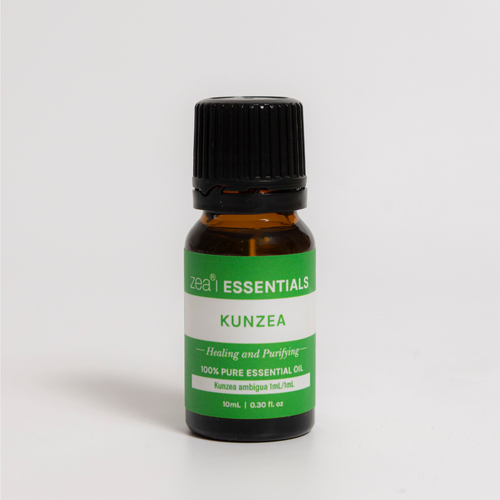
Kunzea and Tea Tree are cousins, not twins
Kunzea oil and Tea Tree oil are both Australian, both steam distilled, and both members of the Myrtaceae plant family, but their chemistry is quite different and so are the jobs each oil does best. Tea Tree (Melaleuca alternifolia) has decades of antimicrobial research behind it1 and is the right pick for blemish-prone skin, minor cuts and household cleaning. Kunzea (Kunzea ambigua) has a gentler chemical profile suited to topical comfort products, massage and aromatherapy, with a younger but growing research base2. Neither oil is "better" across the board. Here is how they actually compare.
Kunzea vs Tea Tree at a glance
The table below summarises the main differences. Details on each point follow underneath.
| Kunzea oil | Tea Tree oil | |
|---|---|---|
| Botanical name | Kunzea ambigua | Melaleuca alternifolia |
| Plant family | Myrtaceae | Myrtaceae |
| Origin | Tasmania, grown in sustainable plantations as well as wild harvested | Northern NSW and QLD, mostly plantation grown |
| Dominant constituent | Alpha-Pinene (~35-50%) | Terpinen-4-ol (~35-48%) |
| Other key constituents | 1,8-Cineole (~10-15%), Globulol, Viridiflorol, Bicyclogermacrene, Alpha-Terpineol (~2%) | Gamma-Terpinene, Alpha-Terpinene |
| Scent | Clean, fresh, camphoraceous-woody, generally softer | Sharp, medicinal, strongly camphoraceous |
| Strongest evidence base | Topical comfort, skin soothing, aromatherapy (younger research field) | Antimicrobial and antifungal activity (extensive, long-established) |
| Typical best use | Muscle and joint comfort products, massage, diffusion | Blemish care, minor wound cleansing, cleaning products |
| Scale of production | Small specialty crop, Tasmania | Large established industry, hundreds of tonnes a year |
The quick summary: if you want antimicrobial or antifungal support, Tea Tree has the research depth. If you want an oil for a post-exercise rub, a massage blend for tired muscles, or a topical product to help relieve everyday aches, Kunzea's profile is the better fit.

Same family, different genus, different chemistry
Kunzea and Tea Tree share a plant family, Myrtaceae, which also includes Eucalyptus and Melaleuca more broadly. That shared ancestry means both oils carry some overlapping aromatic compounds and a family resemblance in scent, but they belong to different genera: Kunzea and Melaleuca. Different genus means genuinely different chemistry, not just a different label.
Tea Tree oil's identity is built almost entirely around one molecule, Terpinen-4-ol, alongside Gamma-Terpinene and Alpha-Terpinene, with 1,8-Cineole deliberately kept low because high Cineole is associated with skin irritation in some Tea Tree chemotypes1. This chemical consistency is one reason Tea Tree has been so easy to research: labs around the world are testing oils with a similar, defined constituent profile.
Kunzea oil has no equivalent international standard, but published composition data from University of Tasmania researchers shows a consistent pattern: Alpha-Pinene typically makes up 35-50% of the oil, with 1,8-Cineole around 10-15%, and a distinctive fraction of sesquiterpene alcohols, Globulol and Viridiflorol, each usually 5-10%, though the exact balance shifts with harvest season and cutting method2. Bicyclogermacrene and Alpha-Terpineol (around 2%) round out the profile. That combination of a high-monoterpene top note with sesquiterpene alcohols underneath is not something Tea Tree shares, and it is a large part of why the two oils feel and behave differently on skin.
Scent: sharp and medicinal vs soft and fresh
Aroma is the fastest way most people notice the difference. Tea Tree's scent is sharp, medicinal and strongly camphoraceous, a smell many people associate instantly with first aid kits and cleaning products. It is effective, but it is not universally loved.
Kunzea's scent is softer: clean, fresh and camphoraceous-woody, without the same medicinal edge. People who find Tea Tree too sharp for massage oils, diffuser blends or everyday use often find Kunzea easier to live with. This is a subjective, personal preference rather than a chemistry fact, but it is consistently the first thing people comment on when comparing the two oils side by side.
Where the evidence actually points
Honesty matters here more than brand loyalty. Tea Tree oil has an extensive, decades-deep research base on antimicrobial and antifungal activity, much of it built around Terpinen-4-ol specifically1. That evidence base is why Tea Tree is the default recommendation for blemish-prone skin, minor cuts and grazes, and DIY cleaning blends, and it is not a claim Kunzea can currently match.
Kunzea's research base is younger and smaller. Early studies on Kunzea's constituents, Alpha-Pinene, 1,8-Cineole, Viridiflorol and Globulol, point toward topical comfort and skin-soothing potential rather than antimicrobial strength2, but the body of published research specific to Kunzea oil itself is still growing compared with Tea Tree's decades of literature. One early Tasmanian study even tested Kunzea oil as a mosquito repellent and found it performed comparably to 40% citronella, though well below DEET, illustrating how a promising early result still needs a great deal more evidence before it becomes a reliable use case3. This is why Zea's own product claims stay tightly scoped: topical products containing Kunzea oil that are listed on the ARTG (AUST L 360 331) may help relieve muscular aches and pains4, and that structure/function claim applies to the finished, listed product, not to the raw essential oil. The raw oil itself carries no therapeutic claim, only its established use in aromatherapy and general topical-comfort applications5.
Put simply: Tea Tree wins on antimicrobial evidence, comfortably. Kunzea's strength lies elsewhere, in topical comfort formulations and aromatherapy, backed by a smaller but real and growing body of research.
Can you substitute one for the other?
Sometimes, but not always. In a diffuser blend built purely around scent, Kunzea can generally stand in for Tea Tree if you want a softer, less medicinal aroma with a similar fresh, woody character. Both blend well with citrus oils, Lavender and other Myrtaceae oils from Zea's wider essential oils range.
For anything relying on Tea Tree's antimicrobial action, a DIY surface spray, a blemish spot treatment, a scalp cleanse, Kunzea is not an equivalent substitute. Its chemistry simply is not built for that job, and swapping it in on the assumption that "they're both Australian native oils" would be a mismatch of ingredient to purpose. Choose based on what you actually need the oil to do, not just its country of origin or general "natural oil" category.
Why Kunzea costs more per millilitre
Tea Tree is a large, established industry producing hundreds of tonnes of oil annually from plantations across northern NSW and Queensland. Kunzea remains a small specialty crop, grown in sustainable plantations as well as wild harvested in Tasmania, with nowhere near the same production volume2. The same native shrub also produces the nectar behind Zea's single-origin Kunzea Honey, a link we explore in our World Honey Bee Day article on raw Australian honey. Lower supply against steady demand is the simple economic reason genuine Tasmanian Kunzea oil usually costs more per millilitre than Tea Tree. It is not a reflection of superior quality on either side, just a smaller harvest.
Choosing the right oil for the job
- Want antimicrobial or antifungal support? Tea Tree is the better-evidenced choice.
- Want a topical comfort product for muscle or joint aches? Kunzea's profile, and ARTG-listed products built around it, are the better fit.
- Want a softer scent for massage or diffusion? Kunzea is generally considered gentler on the nose.
- Building a DIY cleaning spray? Tea Tree, for its established antimicrobial data.
- Not sure, and just want a clean Tasmanian bushland scent? Kunzea is the easier everyday oil to live with.

Many households simply keep both, using each for what it does best. If you want to see how Kunzea's constituents translate into a finished topical product, Kunzea Pain Relief Cream is Zea's cream registered with the ARTG (AUST L 360 331), built around this ingredient. For the full constituent breakdown and sourcing detail behind Kunzea oil, see our companion guide, What Is Kunzea Oil? Composition, Benefits and How It Compares to Tea Tree, and browse the wider range in the All Zea Kunzea Products collection. For plain-English detail on any ingredient mentioned here, the Zea Ingredient Glossary is a good next stop.
Frequently asked questions
Is Kunzea oil the same as Tea Tree oil?
No. They are both Australian Myrtaceae oils, but they come from different plant genera, Kunzea and Melaleuca, with different dominant constituents. Tea Tree is led by Terpinen-4-ol and researched mainly for antimicrobial uses. Kunzea is led by Alpha-Pinene and 1,8-Cineole with sesquiterpene alcohols behind them, a profile suited to topical comfort and aromatherapy.
Which smells better, Kunzea or Tea Tree?
This comes down to personal preference, but most people find Kunzea's scent softer and easier to live with. Kunzea is clean, fresh and camphoraceous-woody, while Tea Tree is sharper and more medicinal. Many diffuser and massage blend users prefer Kunzea for exactly this reason.
Can I substitute Kunzea for Tea Tree in a diffuser blend?
For scent alone, generally yes. Kunzea gives a similar fresh, bushland character with a gentler edge. For uses relying on Tea Tree's antimicrobial action, such as a surface spray or blemish treatment, Kunzea is not an equivalent substitute.
Is Kunzea oil antibacterial like Tea Tree?
Tea Tree has the stronger evidence base by a wide margin, with decades of published antimicrobial research. Early studies exist on some of Kunzea's constituents, but the research specific to Kunzea oil is comparatively young, and no therapeutic or antimicrobial claim is made for the raw oil itself.
Why is Kunzea oil more expensive than Tea Tree?
Simple supply and demand. Tea Tree is produced at industrial scale from established plantations, while Kunzea remains a small specialty crop grown in sustainable plantations as well as wild harvested in Tasmania. Lower production volume against steady demand keeps the price per millilitre higher.
Are Kunzea and Tea Tree from the same plant family?
Yes, both belong to the Myrtaceae family, along with Eucalyptus. They are cousins within that family rather than the same species. Kunzea comes from Kunzea ambigua and Tea Tree from Melaleuca alternifolia, different genera with meaningfully different chemistry.
References
Sources open in a new tab so you do not lose your place.
- 1. Carson CF, Hammer KA, Riley TV. Melaleuca alternifolia (Tea Tree) Oil: a Review of Antimicrobial and Other Medicinal Properties. Clinical Microbiology Reviews. 2006;19(1):50-62. View source
- 2. Park C, Garland SM, Close DC. The Effect of the Height of Coppicing and Harvest Season on the Yield and Quality of the Essential Oil of Kunzea ambigua. Plants (Basel). 2022;12(1):20. University of Tasmania. View source
- 3. Thomas J, Webb CE, Narkowicz C, et al. Evaluation of Repellent Properties of Volatile Extracts from the Australian Native Plant Kunzea ambigua Against Aedes aegypti. Journal of Medical Entomology. 2009;46(6):1387-91. University of Tasmania. View source
- 4. Therapeutic Goods Administration. Australian Register of Therapeutic Goods entry 360331. View source
- 5. healthdirect Australia. Aromatherapy. View source