World Honey Bee Day falls on the third Saturday of August each year, and in 2026 that is Saturday 15 August. It began in the United States in 2009 as a way for beekeepers to raise awareness of the role honey bees play in food production, and it has since spread into an informal global observance.1 Roughly one third of the food humans eat depends, at some point in its production, on animal pollinators, and honey bees are the most economically significant of them.2 That single fact is also why the honey on your kitchen shelf tastes the way it does. Healthy, well-foraging bee populations are the entire reason single-origin, raw honey exists in a recognisable, traceable form at all.
This article looks at that chain directly: what a healthy bee population in Australia actually means for the honey it produces, why raw honey is handled differently to the honey most people grew up with, why a jar of single-origin Kunzea or wildflower honey can taste different from batch to batch, and the practical questions people ask about storing and understanding raw honey.

What is World Honey Bee Day, and why does it matter to honey drinkers?
World Honey Bee Day is not a government-declared holiday and it has no single official sponsor. It grew out of grassroots beekeeping communities in the US who wanted a day to talk publicly about pollinator health, and it has been adopted informally by beekeepers, food producers and pollinator-advocacy groups well beyond America since.1 It sits alongside the United Nations' own World Bee Day on 20 May, which the UN General Assembly formally adopted in 2017 to highlight the same issue at government level.3 Between the two, most of the calendar year has some form of bee-awareness moment attached to it, which says something about how seriously food-security researchers take the underlying issue.
For a honey buyer, the practical relevance is simple: a jar of honey is a direct record of what a bee colony foraged, when, and how healthy that colony was while it did it. A day built around bee awareness is, indirectly, a day about honey quality and availability too.
Why healthy bee populations are the whole story behind honey quality
A honey bee colony's foraging range typically runs a few kilometres out from the hive, and within that range the bees will visit whatever is flowering in volume at the time. If the colony is healthy and the surrounding land offers strong, unbroken stands of a single native plant such as Kunzea, the bees will forage predominantly on that plant while it flowers, and the resulting honey carries that plant's nectar characteristics through to the jar: colour, aroma, viscosity, the lot. If the colony is stressed, under-populated or forced to forage across many scattered, weaker sources, the honey becomes a blend of whatever was nearby, with no single dominant character.
This is why "healthy bees" is not an abstract sustainability talking point when you are talking about raw, single-origin honey. It is a direct input into the product. A weakened hive produces less honey overall, forages less selectively, and is more likely to need supplementary feeding, all of which change what ends up in the jar. Australia has historically had some real structural advantages here: large tracts of native bushland with dense flowering, and, until recently, freedom from Varroa mite, the parasite that has hammered honey bee populations across most of the rest of the world for decades.
That changed in June 2022, when Varroa was detected near the Port of Newcastle in New South Wales, ending Australia's long run as the last mainland-scale honey bee population free of the mite.4 Eradication was attempted and ultimately abandoned in September 2023 in favour of a transition to ongoing management, the same approach beekeeping industries in the US, Europe and New Zealand have used for years.4 The practical upshot for the honey industry is that Australian beekeepers are now managing a pest that raises the cost and complexity of keeping colonies healthy, which is exactly the kind of pressure that makes a producer's foraging environment and hive management more important, not less.
Raw honey vs regular honey: what actually changes
"Raw" is a processing description, not a marketing flourish, and the difference between raw and heavily processed honey is genuinely measurable. Most supermarket honey is pasteurised (heated well above what a hive naturally reaches) and ultra-filtered to remove pollen, wax fragments and any visible particulate, producing a honey that stays liquid, clear and shelf-stable for a very long time. Raw honey skips both steps: it is extracted from the comb, lightly strained to remove wax and debris, and bottled without heat treatment or fine filtration.
The table below sets out the practical differences without straying into anything the honey itself can't back up.
| Attribute | Raw honey | Heavily processed honey |
|---|---|---|
| Heat treatment | Not pasteurised, or minimal warming to ease bottling | Pasteurised at high temperature for shelf stability |
| Filtration | Coarsely strained only; retains pollen and fine particulates | Ultra-filtered; pollen and particulates largely removed |
| Enzyme content | Higher; heat degrades naturally occurring enzymes such as Glucose Oxidase | Lower after pasteurisation |
| Texture over time | Crystallises naturally; texture and appearance change | Stays liquid for longer; engineered for shelf appeal |
| Batch-to-batch variation | Visible; colour and flavour shift with season and floral source | Minimal; often blended across regions and seasons to standardise |
None of this makes raw honey a medicine or a treatment for anything, and we are not going to pretend otherwise. It is a less-processed food product with more of its original character intact: natural sugars, trace enzymes, and pollen from whatever the bees were foraging. That is the honest, food-based case for raw honey, and it is a genuinely good one without needing to be dressed up as something else.
Single-origin honey: why the same product can taste different every batch
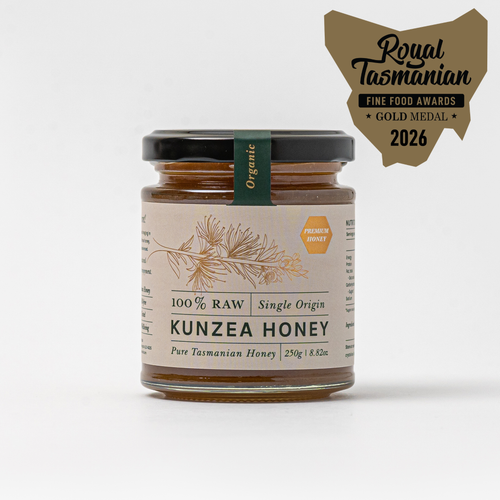
Single-origin honey means the colony foraged predominantly on one flowering plant during the period that honey was collected, rather than a rotating mix of whatever was available across a season. Kunzea Honey is a clear example: bees kept near stands of flowering Kunzea ambigua, the same native Tasmanian shrub Zea uses for its Kunzea oil range (see our full guide to Kunzea oil's composition and how it compares to Tea Tree oil), forage heavily on its blossom while it is out, and the resulting honey carries Kunzea's distinctive aromatic character.

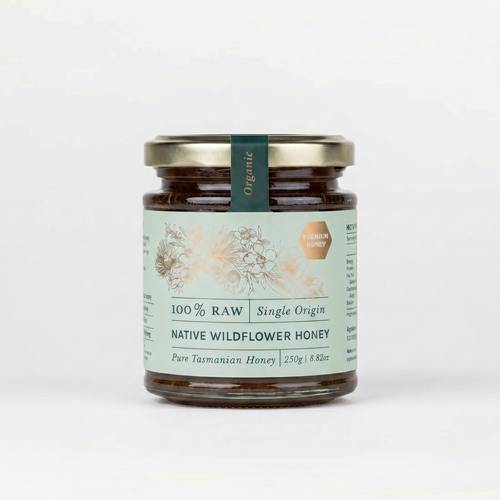
Wildflower honey works differently by design: it is a botanical blend, drawing on whatever native flora is in bloom across a foraging season, which is why its flavour, colour and aroma shift more noticeably from batch to batch than a single-origin honey does. Neither approach is "better" in an absolute sense. They are different products with different personalities, and the variation itself is the tell that the honey is genuinely raw and genuinely tied to a real place and season, rather than blended down to a standardised, always-identical taste. A jar that tastes exactly the same in every batch, indefinitely, usually means active production choices are being made to keep it that way. The full Zea Gourmet range carries both approaches, alongside other single-origin and blended Tasmanian honeys, and sits within the wider All Zea Kunzea Products collection.
Kunzea itself is worth a closer look for another reason: the same native shrub the bees forage for Kunzea Honey is also steam-distilled into Kunzea oil, the active ingredient behind Zea's pain relief range. It is a rare case of one native plant supporting a food product and a therapeutic product, such as Zea's Kunzea Pain Relief Cream, at the same time, without any overlap in claims between the two.
That variation is also a direct line back to the first section of this article. Single-origin honey only exists if a bee population stays healthy enough, and the floral source stays intact enough, for a colony to forage predominantly on one plant for a full flowering period. Remove either the bees or the botanical density, and single-origin honey quietly becomes a wildflower blend by default, because that is what the bees are forced to do.
How to store raw honey (and why it crystallises)
Raw honey crystallises. That is normal, expected, and not a sign anything has gone wrong. Honey is a supersaturated sugar solution, meaning it holds more dissolved sugar than water could normally dissolve at room temperature, and over time that excess sugar (mostly glucose) comes out of solution as fine crystals. Raw honey crystallises faster than heavily processed honey specifically because it has not been fine-filtered: the pollen grains and fine particulates that survive raw processing act as seed points crystals can form around.
A few practical points on storage:
- Store at room temperature, not the fridge. Refrigeration speeds up crystallisation dramatically. A cool, dry pantry cupboard is ideal.
- Keep the lid sealed between uses. Honey is hygroscopic, meaning it absorbs moisture from the air, and excess moisture is what allows fermentation to set in over long periods.
- If it crystallises, that is not spoilage. Sit the jar (lid on) in a bowl of warm, not boiling, water for 10 to 15 minutes and stir gently. This dissolves the crystals without pasteurising the honey or damaging its natural enzyme content the way high heat would.
- Use a dry spoon each time. Introducing water into the jar (a wet spoon, condensation) is the main way honey ferments in storage.
- Expect colour and texture to shift over the jar's life. A raw honey that looks slightly different at the end of the jar to when it was opened is behaving normally, not deteriorating.

Frequently asked questions
What is World Honey Bee Day and when is it?
World Honey Bee Day is an informal awareness observance held on the third Saturday of August each year, so in 2026 it falls on Saturday 15 August. It started with US beekeeping communities in 2009 to draw attention to honey bee health and its role in food production, and has spread as a grassroots observance since.1 It is separate from the United Nations' World Bee Day, held on 20 May.3
What is the difference between raw and regular honey?
Raw honey is extracted from the comb and only coarsely strained, with no pasteurisation and no fine filtration, so it retains pollen, fine particulates and more of its natural enzyme content. Regular (heavily processed) supermarket honey is typically pasteurised and ultra-filtered for a longer shelf life and a clear, always-liquid appearance. Both are honey; they have simply been handled differently after the hive.
Why does single-origin honey taste different from batch to batch?
Because it reflects a real, specific foraging season rather than a standardised blend. A single-origin honey like Kunzea Honey depends on bees foraging predominantly on one flowering native plant during a limited window, so seasonal conditions (rainfall, flowering intensity, temperature) genuinely change the colour, aroma and flavour of each batch. That variation is a sign of authenticity, not a quality problem.
What is Kunzea honey?
Kunzea Honey is a single-origin raw honey produced by bees foraging predominantly on Kunzea ambigua, a native Tasmanian shrub, while it flowers. It is the same plant Zea uses to produce its Kunzea oil range, so the honey and the oil share a botanical origin even though they are entirely separate product categories with separate uses.
How should raw honey be stored, and why does it crystallise?
Store raw honey at room temperature in a sealed jar, out of the fridge, using a dry spoon each time. Crystallisation happens because honey holds more dissolved sugar than water can normally sustain at room temperature, and raw honey's retained pollen and particulates give those sugar crystals more surface area to form around. It is entirely normal and easily reversed with gentle, low-heat warming.
How can I support healthy bee populations in Australia?
Plant local, pollinator-friendly native flora if you have any garden space at all, avoid spraying flowering plants with pesticide during daylight foraging hours, and buy honey from producers who can tell you where and how it was sourced. Since Varroa mite's arrival in 2022, Australian beekeepers are managing an ongoing pest pressure that did not exist here before, and demand for well-managed, traceable honey is one of the more direct ways consumers support that work.4
References
Sources open in a new tab so you do not lose your place.
- 1. Wikipedia. National Honey Bee Day. View source
- 2. Food and Agriculture Organization of the United Nations. World Bee Day. View source
- 3. United Nations. World Bee Day, 20 May. View source
- 4. Australian Government. National Varroa mite response and transition to management. View source