
You rub a pain relief cream onto a sore shoulder, and within seconds you feel it, that distinctive tingling, warming, or cooling sensation spreading across your skin. For most of us, it’s become a kind of signal: this is working. But here’s the question worth asking: is that tingle actually doing anything? Or is your body being cleverly tricked?
The answer depends entirely on what’s causing the tingle, and not all tingles are created equal.
In this blog, we'll break down the science behind common tingling ingredients, explain why a strong sensation doesn't always mean deep relief, and explore the botanical alternatives that go beyond the tingle to actually support your body's healing.
Your Skin Has Its Own Sensory Receptors
Before we get into ingredients, it helps to understand a little about how your skin talks to your brain.
Your skin is packed with nerve endings that monitor your environment, sensing temperature, pressure, and potential danger. Woven into these nerve endings are tiny molecular sensors called TRP channels (Transient Receptor Potential channels). Think of them as biological switches that respond to specific signals.
When a TRP channel detects a compound it recognises, such as the coolness of Menthol or the heat of Capsaicin, it sends a signal to your brain. Your brain then translates that as a sensation: cool, warm, tingly, or a mix of all three.
Here’s the important part: feeling that sensation and healing the underlying cause are two very different things.
The Common Tingling Ingredients And What They’re Actually Doing
Menthol
Menthol is derived from Peppermint and other plants in the Mentha family. It works by activating the TRPM8 receptor, the same one your skin uses to sense cold temperatures. When Menthol binds to TRPM8, your brain receives a “cold” signal even though the temperature hasn’t changed. That’s the cooling tingle.
Menthol does have some pain-modulating properties, but its primary mechanism is sensory substitution: it replaces the sensation of pain with the sensation of cold, giving your brain something else to focus on. Researchers call this the Gate Control Theory of pain: a competing sensation “closes the gate” on pain signals. It can offer real short-term comfort, but it’s not addressing what’s driving the pain underneath.

Capsaicin
Capsaicin is the active compound in chilli peppers. It targets TRPV1, the receptor that detects painful heat, which is why Capsaicin products feel warm or burning on the skin. The theory is desensitisation: after repeated activation, TRPV1 becomes fatigued and pain signals temporarily reduce. But the initial burning is intense, it requires multiple applications, and it doesn’t reduce the inflammation causing the pain. It simply turns down your body’s ability to feel it.
Camphor
Camphor activates both TRPV1 and TRPV3 receptors, creating a warming sensation that desensitises quickly. Like Capsaicin, relief comes through sensory stimulation followed by receptor fatigue, not direct anti-inflammatory action. A short-term sensory effect.
The Problem With “Tingle = Relief”
Menthol, Capsaicin, and Camphor are all classified as counterirritants, ingredients that work by creating a new sensation to override an existing one. They don’t reduce inflammation. They don’t support tissue repair. They don’t address the root cause of pain.
What they do is hijack your sensory system long enough to give you a break from the discomfort. For some situations; a sore muscle after exercise or a minor strain, that might be enough. But for ongoing joint pain, inflammation, or post-activity recovery, sensory distraction alone isn’t a solution.
The tingling feeling these ingredients create can be convincing. It feels like something significant is happening. But the feeling of intensity doesn’t correlate with therapeutic depth.
Ingredients That Do More Than Tingle
Kunzea
Kunzea (Kunzea ambigua) is a native Tasmanian plant with a rich sesquiterpene profile that gives it genuine anti-inflammatory and analgesic properties. Unlike counterirritants, Kunzea works with your body’s healing processes rather than overriding its sensory signals.
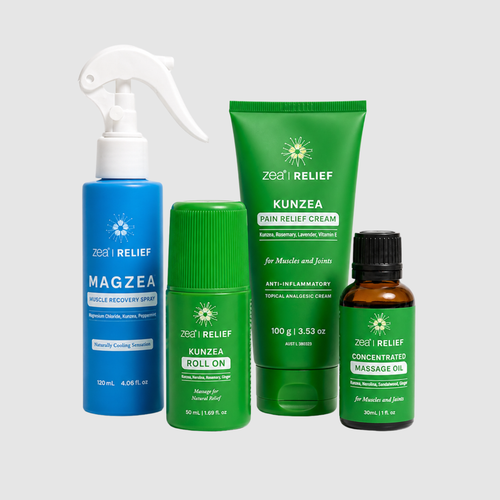
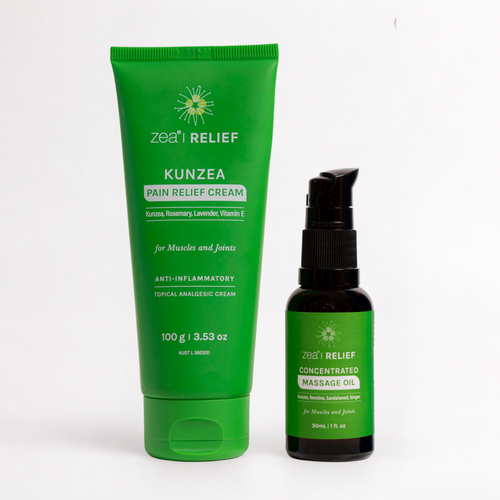
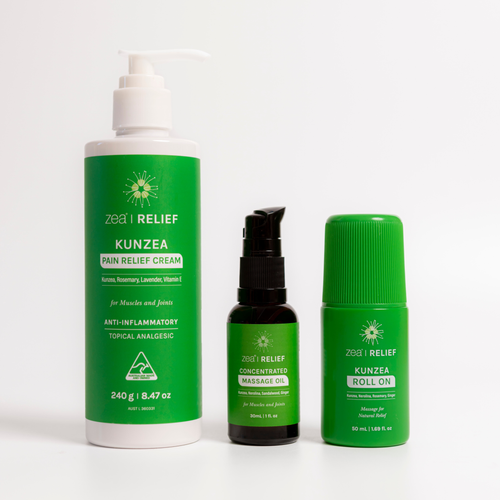
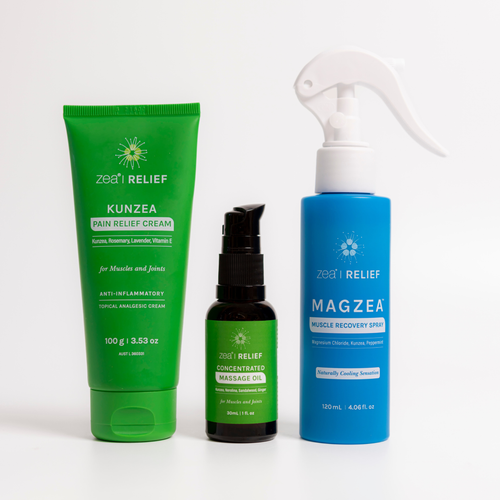
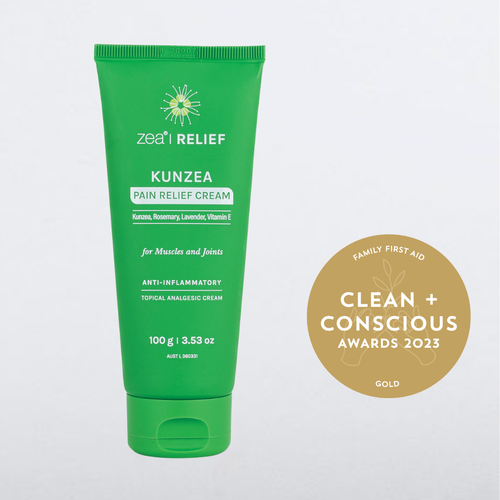
It’s notably gentle on the skin, well tolerated and non-irritating, even at higher concentrations. What you do feel with Zea’s Kunzea Pain Relief Cream is a light, refreshing coolness on application; a pleasant sensation, not an overwhelming tingle. That subtle cool is a reassuring sign Kunzea is getting to work without overstimulating your skin.

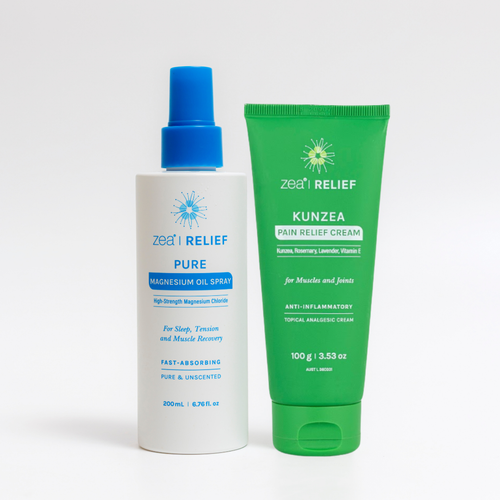
Kunzea Pain Relief Cream also contains Rosemary Extract, a rich source of anti-inflammatory compounds that support circulation and immune response, and Tasmanian Lavender Oil to soothe skin inflammation, alongside Vitamin E for antioxidant and skin-protective support.
Ginger
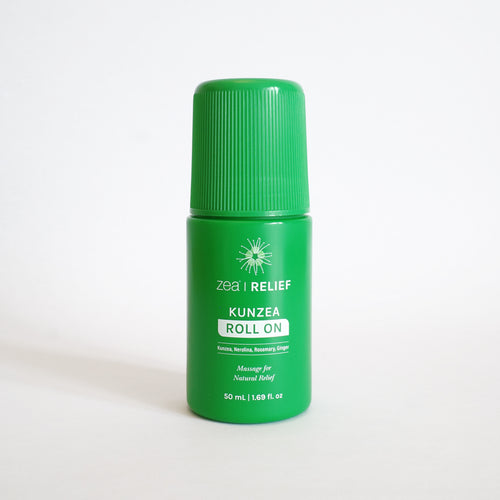
Ginger is used across our Concentrated Massage Oil, Kunzea Roll On and Multi-Purpose Rescue Balm. Ginger is one of the most well-researched natural anti-inflammatories available. Its active compounds, Gingerols and Shogaols inhibit COX-2 enzymes, helping reduce inflammation in tissue. Applied topically, it’s warming and stimulating in a therapeutic sense, not just a sensory one.
Eucalyptus
Eucalyptus features across several Zea Relief products. Its primary compound, Eucalyptol, has been shown to block TRPV1 activity, reducing pain signalling rather than just creating a competing sensation, alongside broader anti-inflammatory effects in tissue.
Does Tingling Mean It’s Working?
Not necessarily, and that’s the key distinction.
A strong tingle tells you that your skin’s sensory receptors are being activated. It doesn’t tell you whether inflammation is being reduced, whether circulation is improving, or whether your tissue is getting real support.
Some of the most effective natural ingredients including Kunzea, Ginger, and Eucalyptus, produce a relatively mild sensation on application. Others, like Capsaicin and Camphor, produce an intense one. The intensity of the feeling doesn’t predict the depth of the therapy.
What actually matters is:
• Does the ingredient reduce the underlying inflammation?
• Is it supporting tissue recovery, not just masking discomfort?
• Can you use it consistently, long-term, without irritating your skin?
Why Some People Are More Sensitive Than Others
The same product can feel completely different person to person. This comes down to TRP receptor sensitivity (genetics and prior exposure), skin condition (thinner or already-inflamed skin reacts more intensely), and frequency of use. With Capsaicin in particular, the tingle decreases over time as receptors desensitise.
When Tingling Becomes Too Much
A mild tingle or cooling sensation is normal. But if you experience burning or stinging that doesn’t settle after a few minutes, redness, rash, or swelling at the application site, or increased discomfort rather than relief, your skin may be reacting to a specific ingredient. Wash gently and check the ingredient list. A patch test before applying any new product to a large area is always a good idea.
A Different Approach to Pain Relief
The key takeaway? A strong tingle might feel convincing, but it’s not a reliable sign that your body is actually healing.
True pain relief goes beyond sensation. It’s about reducing inflammation, supporting recovery, and working with your body, not distracting it.
At Zea, we’ve built our range around natural ingredients that do real work, not just ingredients that feel like they do. No overwhelming burn. No fading-fast tingle that leaves you wondering if anything actually happened. Just thoughtfully formulated, botanically grounded relief, the kind your body can use.
Shop the Zea range for natural pain relief that works beyond the surface.
References
-
Anand, P., & Bley, K. (2011). Topical capsaicin for pain management. British Journal of Anaesthesia, 107(4), 490-502. https://doi.org/10.1093/bja/aer260
-
Karashima, Y., Damann, N., Prenen, J., Talavera, K., Segal, A., Voets, T., & Nilius, B. (2007). Bimodal action of menthol on the transient receptor potential channel TRPA1. The Journal of neuroscience : the official journal of the Society for Neuroscience, 27(37), 9874-9884. https://doi.org/10.1523/JNEUROSCI.2221-07.2007
-
Li, Z., Zhang, H., Wang, Y., Li, Y., Li, Q., & Zhang, L. (2022). The distinctive role of menthol in pain and analgesia: Mechanisms, practices, and advances. Frontiers in molecular neuroscience, 15, 1006908. https://doi.org/10.3389/fnmol.2022.1006908
-
Raj, A. (2022). Counterirritants and sensory profiling of topical analgesics. International Journal of Pharmaceutical and Biological Medical Sciences, 2(11), 466-478. https://ijpbms.com/index.php/ijpbms/article/download/166/108
-
Van Breemen, R. B., Tao, Y., & Li, W. (2011). Cyclooxygenase-2 inhibitors in ginger (Zingiber officinale). Fitoterapia, 82(1), 38-43. https://doi.org/10.1016/j.fitote.2010.09.004
-
Xu, H., Delling, M., Jun, J. C., & Clapham, D. E. (2005). Camphor activates and strongly desensitizes TRPV1. Journal of Neuroscience, 25(39), 8924-8937. https://doi.org/10.1523/JNEUROSCI.2574-05.2005
![Kunzea Pain Relief Cream [Value Pack]](http://www.zeaaustralia.com/cdn/shop/files/Neutral_Images_Website_1080_x_1080_12_aeeb7fb5-6b18-4315-99ea-c7a97403e37a.png?v=1776732033&width=500)


